

VOPRA
vonoprazan
- Strength
- 10/20
- Dosage form
- tablets
- Pack size
- 10*10
- Packing
- blister
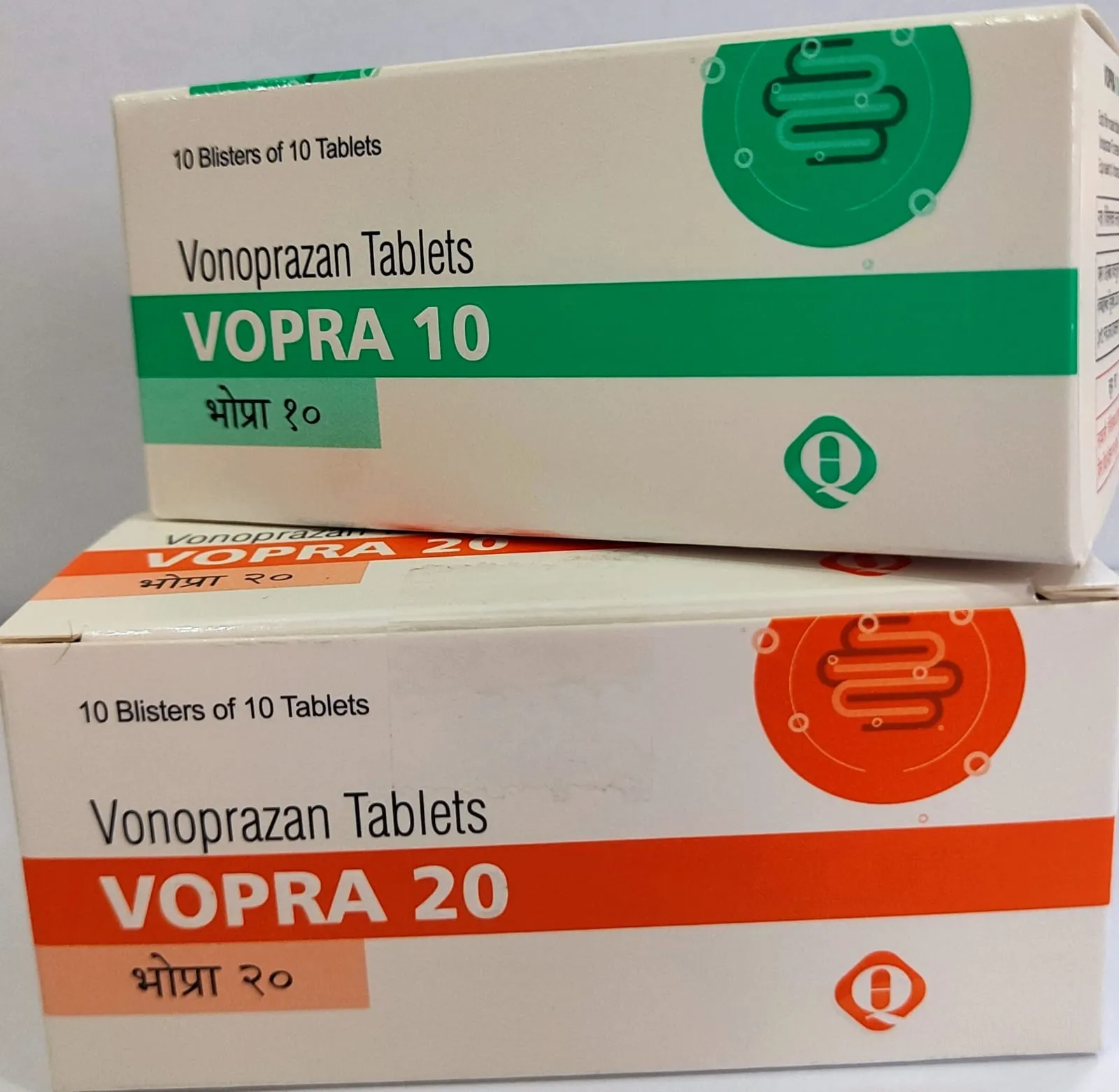
Product information
PRESENTATION
Dosage Form: Film Coated Tablet
Generic: Vonoprazan Fumarate as Vonoprazan
Pharmacopoeia: IHS
Strength: 10/20 mg
Pack Size: 10*10
Packing: Blister
Group: KHA
CLINICAL PARTICULARS
Indications
- For healing of all grades of erosive esophagitis and relief of heartburn associated with erosive esophagitis in adults.
- To maintain healing of all grades of erosive esophagitis and relief of heartburn associated with erosive esophagitis in adults.
- In combination with amoxicillin and clarithromycin for the treatment of Helicobacter pylori (H. pylori) infection in adults.
- In combination with amoxicillin for the treatment of H. pylori infection in adults.
DOSAGE AND ADMINISTRATION
Recommended Dosage
Healing of Erosive Esophagitis and Relief of Heartburn
- The recommended adult oral dosage is VPRAZ 20 mg once daily for 8 weeks.
Maintenance of Healed Erosive Esophagitis and Relief of Heartburn
- The recommended adult oral dosage is VPRAZ 10 mg once daily for up to 6 months.
Treatment of H. pylori Infection
- Triple Therapy: The recommended adult oral dosage is VPRAZ 20 mg plus amoxicillin 1,000 mg plus clarithromycin 500 mg, each given twice daily (in the morning and evening, 12 hours apart) for 14 days.
Dual Therapy
- The recommended adult oral dose is VPRAZ 20 mg given twice daily (in the morning and evening) plus amoxicillin 1,000 mg three times daily (in the morning, mid-day, and evening) for 14 days.
- Also refer to the amoxicillin and clarithromycin full prescribing information.
Recommended Dosage in Patients with Renal Impairment
Healing of Erosive Esophagitis
The recommended dosage of VPRAZ in adult patients with renal impairment is described in below.
Table 1: Recommended VPRAZ Dosage in Patients with Renal Impairment: Healing of Erosive Esophagitis.
Estimated glomerular filtration rate (GFR) Recommended Dosage 30 mL/minute or greater 20 mg once daily Less than 30 mL/minute 10 mg once dailyMaintenance of Healed Erosive Esophagitis
The recommended dosage of VPRAZ in adult patients with renal impairment is the same as for adult patients with normal renal function.
Treatment of H. pylori Infection
The recommended dosage of VPRAZ in adult patients with renal impairment is described in below.
Recommended VPRAZ Dosage in Patients with Renal Impairment: Treatment of
H. pylori Infection
Estimated GFR Recommended Dosage
30 mL/minute or greater 20 mg twice daily
Less than 30 mL/minute Use is not recommended
Recommended Dosage in Patients with Hepatic Impairment
Healing of Erosive Esophagitis
The recommended dosage of VPRAZ in adult patients with hepatic impairment is described below.
Recommended VPRAZ Dosage in Patients with Hepatic Impairment: Healing of Erosive Esophagitis
Classification Recommended Dosage
Child-Pugh Class A 20 mg once daily
Child-Pugh Class B 10 mg once daily
Child-Pugh Class C 10 mg once daily
Maintenance of Healed Erosive Esophagitis
The recommended dosage of VPRAZ in adult patients with hepatic impairment is the same as for patients with normal hepatic function.
Treatment of H. pylori Infection
The recommended dosage of VPRAZ in adult patients with hepatic impairment is described below.
Recommended VPRAZ Dosage in Patients with Hepatic Impairment: Treatment of H. pylori Infection
Classification Recommended Dosage
Child-Pugh Class A 20 mg twice daily
Child-Pugh Class B Use is not recommended
Child-Pugh Class C Use is not recommended
Administration Instructions
Take VPRAZ with or without food.
Swallow VPRAZ tablets whole; do not chew or crush the tablet.
Missed Doses:
For The Healing or Maintenance of Healed Erosive Esophagitis:
If a dose is missed, administer VPRAZ as soon as possible within 12 hours after the missed dose.
If more than 12 hours have passed, skip the missed dose and administer the next dose at the regularly scheduled time.
For The Treatment of H. Pylori Infection:
If a dose is missed, administer VPRAZ as soon as possible within 4 hours after the missed dose. If more than 4 hours have passed, skip the missed dose and administer the next dose at the regularly scheduled time.
Continue the normal dosing schedule until the treatment is completed.
CONTRAINDICATIONS
- Hypersensitivity to vonoprazan or any component of VPRAZ.
- Rilpivirine-containing products.
- Antibacterial agents (clarithromycin and amoxicillin)
WARNINGS AND PRECAUTIONS
Presence of Gastric Malignancy
In adults, symptomatic response to therapy with VPRAZ does not preclude the presence of gastric malignancy. Consider additional follow-up and diagnostic testing in patients who have a suboptimal response or an early symptomatic relapse after completing treatment with VPRAZ. In older patients, also consider endoscopy.
Acute Tubulointerstitial Nephritis
Acute tubule interstitial nephritis (TIN) has been reported with VPRAZ.
If suspected, discontinue VPRAZ and evaluate patients with suspected acute TIN.
Clostridioides difficile-Associated Diarrhea
Published observational studies suggest that proton pump inhibitors (PPIs) may be associated with an increased risk of Clostridioides difficile-associated diarrhea (CDAD), especially in hospitalized patients. VPRAZ, another drug that blocks the proton pump to inhibit gastric acid production, may also increase the risk of CDAD. Consider CDAD in patients with diarrhea that does not improve
Use the shortest duration of VPRAZ appropriate to the condition being treated.
CDAD has been reported with use of nearly all antibacterial agents. For more information specific to antibacterial agents (clarithromycin and amoxicillin) indicated for use in combination with VPRAZ, refer to Warnings and Precautions section of the corresponding prescribing information.
Bone Fracture
Several published observational studies suggest that PPI therapy may be associated with an increased risk for osteoporosis-related fractures of the hip, wrist or spine. The risk of fracture was increased in patients who received high-dose, defined as multiple daily doses, and long-term therapy (a year or longer). Bone fracture, including osteoporosis-related fracture, has also been reported with vonoprazan. Use the shortest duration of VPRAZ appropriate to the condition being treated.
Patients at risk for osteoporosis-related fractures should be managed according to the established treatment guidelines.
Severe Cutaneous Adverse Reactions
Severe cutaneous adverse reactions, including Stevens-Johnson syndrome (SJS) and toxic epidermal necrolysis (TEN) have been reported with.
Discontinue VPRAZ at the first signs or symptoms of severe cutaneous adverse reactions or other signs of hypersensitivity and consider further evaluation.
Vitamin B12 (Cobalamin) Deficiency
Long-term use of acid-suppressing drugs can lead to malabsorption of Vitamin B12 caused by hypoor achlorhydria. Vitamin B12 deficiency has been reported post marketing with vonoprazan. If clinical symptoms consistent with Vitamin B12 deficiency are observed in patients treated with VPRAZ consider further workup.
Hypomagnesaemia and Mineral Metabolism
Hypomagnesaemia has been reported post marketing with vonoprazan.
Hypomagnesaemia may lead to hypocalcaemia and/or hypokalemia and may exacerbate underlying hypocalcaemia in at-risk patients.
Consider monitoring magnesium levels prior to initiation of VPRAZ and periodically in patients expected to be on prolonged treatment, in patients taking drugs that may have increased toxicity in the presence of hypomagnesaemia (e.g., digoxin), or drugs that may cause hypomagnesaemia (e.g., diuretics). Treatment of hypomagnesaemia may require magnesium replacement and discontinuation of VPRAZ.
Consider monitoring magnesium and calcium levels prior to initiation of VPRAZ and periodically while on treatment in patients with a preexisting risk of hypocalcaemia (e.g., hypoparathyroidism).
Supplement with magnesium and/or calcium, as necessary. If hypocalcaemia is refractory to treatment, consider discontinuing VPRAZ.
DRUG INTERACTIONS
Antiretrovirals: Rilpivirine, Atazanavir, Nelfinavir
Other Drugs (E.G., Iron Salts, Erlotinib, Dasatinib, Nilotinib, Mycophenolate Mofetil, Ketoconazole/Itraconazole)
Cyp2c19 Substrates (E.G., Clopidogrel, Citalopram, Cilostazol)
Cyp2c19 Substrate Drugs (E.G., Citalopram, Cilostazol).
ADVERSE REACTIONS
The following serious adverse reactions are described elsewhere in labeling:
- Acute Tubulointerstitial Nephritis
- Clostridioides difficile-Associated Diarrhea
- Bone Fracture [see Warnings and Precautions
- Severe Cutaneous Adverse Reactions
- Vitamin B12 (Cobalamin) Deficiency
- Hypomagnesaemia and Mineral Metabolism
- Fundic Gland Polyps
Clinical Trials Experience
Because clinical trials are conducted under widely varying conditions, adverse reaction rates observed in the clinical trials of a drug cannot be directly compared to rates in the clinical trials of another drug and may not reflect the rates observed in practice.
Healing of Erosive Esophagitis and Maintenance of Healed Erosive Esophagitis
The safety of Vonoprazan was evaluated in a randomized, active-controlled, double-blind two phase trial for the healing of erosive esophagitis (2 to 8 weeks) and maintenance of healed erosive esophagitis (through 24 weeks) conducted in the United States and Europe.
Adverse reactions reported in at least 2% of patients in the VPRAZ arm in the healing phase are presented below:
Blood and Lymphatic System Disorders: Anemia, Lymphocytosis
Cardiac Disorders: Tachycardia
Ear and Labyrinth Disorders: Vertigo
Gastrointestinal Disorders: Duodenal Polyp, Dry Mouth, Dysphagia, Eructation, Flatulence, Gastric Polyps, Vomiting
General Disorders and Administrative Site Conditions: Asthenia, Peripheral Edema
Infections and Infestations: Upper Respiratory Infection
Investigations: Increased Liver Function Test
Metabolism and Nutritional Disorders: Diabetes Mellitus
Musculoskeletal System: Bone Fracture
Nervous System Disorders: Dizziness, Headache, Syncope
Psychiatric Disorders: Depression, Insomnia
Renal and Urinary Disorders: Tubulointerstitial Nephritis
Skin and Subcutaneous Tissue Disorders: Eczema, Rash, Urticaria
Treatment of H. pylori Infection
The safety of VPRAZ, amoxicillin and clarithromycin was evaluated in 675 adult patients (aged 20 to 82 years) in clinical trials in the United States, Europe and Japan and VPRAZ and amoxicillin was evaluated in 348 adult patients (aged 20 to 80 years) in a clinical trial in the United
States and Europe. All of the patients were screened and found to be positive for H. pylori infection.
The safety of VPRAZ, amoxicillin and clarithromycin (triple therapy) and VPRAZ and amoxicillin (dual therapy) was evaluated in a randomized, controlled, double blind (triple therapy)/open-label (dual therapy) study conducted in the United States and Europe in treatment naïve H. pylori-positive adult patients.
Adverse Reactions Leading to Discontinuation
Treatment discontinuation due to an adverse reaction occurred in 2.3% (8/346) of the patients treated with VPRAZ, amoxicillin and clarithromycin, 0.9% (3/348) of the patients treated with VPRAZ and amoxicillin, and 1.2% (4/345) of the patients treated with lansoprazole, amoxicillin and clarithromycin. The most common adverse reactions leading to discontinuation of VPRAZ, amoxicillin and clarithromycin were diarrhea (0.6%) and hypertension (0.6%) and the most common adverse reaction leading to discontinuation of VPRAZ and amoxicillin was rash (0.6%).
Most Common Adverse Reactions
Blood and Lymphatic System Disorders: Anemia, Leukocytosis, Leukopenia, Neutropenia
Cardiac Disorders: QT Prolongation, Tachycardia
Eye Disorders: Orbital Edema
Gastrointestinal Disorders: Abdominal Distension, Constipation, Dry Mouth, Duodenal Polyp, Duodenal Ulcer, Dyspepsia, Flatulence, Gastric Ulcer, Gastro Esophageal Reflux Disease, Hematochezia, Large Intestine Polyp, Rectal Polyp, Nausea, Stomatitis, Tongue Discomfort, Vomiting
General Disorders and Administration Site Conditions: Fatigue, Pyrexia
Immune System Disorders: Drug Hypersensitivity
Infections and Infestations: Anal Fungal Infection, Gastrointestinal Viral Infection, Oral Fungal Infection, Pneumonia, Tongue Fungal Infection, Upper Respiratory Tract Infection, Urinary Tract Infection, Viral Infection
Investigations: Increased Liver Function Test
Metabolism and Nutrition Disorders: Decreased Appetite
Musculoskeletal System: Bone Fracture
Nervous System Disorders: Ageusia, Dizziness, Tension Headache
Psychiatric Disorders: Anxiety, Depression, Insomnia
Renal and Urinary Disorders: Renal Hypertrophy, Tubulointerstitial Nephritis
Reproductive System and Breast Disorders: Vaginal Discharge
Respiratory, Thoracic and Mediastinal Disorders: Cough, Nasal Polyps, Oropharyngeal Pain
Skin and Subcutaneous Tissue Disorders: Dermatitis, Dry Skin, Rash
USE IN SPECIFIC POPULATIONS
Pregnancy
There are no adequate and well-controlled studies of vonoprazan in pregnant women. Available data from pharmacovigilance reports with vonoprazan-containing products use in pregnant women are not sufficient to evaluate for a drug-associated risk for major birth defects, miscarriage, or other adverse maternal or fetal outcomes.
Lactation
There are no data regarding the presence of vonoprazan in human milk, the effects on the breastfed infant, or the effects on milk production. Vonoprazan and its metabolites are present in rat milk.
Pediatric Use
The safety and effectiveness of VPRAZ have not been established in pediatric patients.
Geriatric Use
No clinically meaningful differences in the pharmacokinetics of vonoprazan are predicted in patients 65 years of age and older compared to younger adult patients.
Renal Impairment
Healing of Erosive Esophagitis
No dosage adjustment of VPRAZ for the healing of erosive esophagitis is recommended in patients with mild to moderate renal impairment (eGFR 30 to 89 mL/min). Dosage reduction is recommended in patients with severe renal impairment (eGFR < 30 mL/min).
Maintenance of Healed Erosive Esophagitis
No dosage adjustment of VPRAZ for the maintenance of healed erosive esophagitis is recommended in patients with any degree of renal impairment.
Treatment of H. pylori Infection
Use of VPRAZ is not recommended for the treatment of H. pylori infection in patients with severe renal impairment (eGFR < 30 mL/min)
Hepatic Impairment
Healing of Erosive Esophagitis
No dosage adjustment of VPRAZ for the healing of erosive esophagitis is recommended in patients with mild hepatic impairment (Child-Pugh A). Dosage reduction is recommended in patients with moderate to severe hepatic impairment (Child-Pugh Class B and C).
Maintenance of Healed Erosive Esophagitis
No dosage adjustment of VPRAZ for the maintenance of healed erosive esophagitis is recommended in patients with any degree of hepatic impairment.
Treatment of H. pylori Infection
Use of VPRAZ is not recommended for the treatment of H. pylori infection in patients with moderate to severe hepatic impairment.
CLINICAL PHARMACOLOGY
Mechanism of Action
Vonoprazan suppresses basal and stimulated gastric acid secretion at the secretory surface of the gastric parietal cell through inhibition of the H+, K+-ATPase enzyme system in a potassium competitive manner. Because this enzyme is regarded as the acid (proton) pump within the parietal cell, vonoprazan has been characterized as a type of gastric proton-pump inhibitor, in that it blocks the final step of acid production. Vonoprazan does not require activation by acid. Vonoprazan may selectively concentrate in the parietal cells in both the resting and stimulated states. Vonoprazan binds to the active pumps in a non-covalent and reversible manner.
Pharmacokinetics
Absorption
Vonoprazan exhibits time independent pharmacokinetics and steady state concentrations are achieved by Day 3 to 4. After multiple doses of vonoprazan ranging from 10 to 40 mg (twice the maximum recommended dose) once daily for 7 days in healthy subjects, Cmax and area under the plasma concentration time curve (AUC) values for vonoprazan increased in an approximately dose proportional manner.
There is little accumulation in plasma after once daily multiple doses, with an accumulation index ratio of less than 1.2 based on AUC for doses ranging from 10 to 40 mg (twice the maximum recommended dose).
Distribution
Plasma protein binding of vonoprazan ranged from 85 to 88% in healthy subjects and was independent of concentration from 0.1 to 10 mcg/mL.
Metabolism
Vonoprazan is metabolized to inactive metabolites via multiple pathways by a combination of cytochrome P450 (CYP) isoforms (CYP3A4/5, CYP2B6, CYP2C19, CYP2C9 and CYP2D6) along with sulfo- and glucuronosyl-transferases. CYP2C19 polymorphisms have been evaluated in clinical studies and there were no considerable differences in the pharmacokinetics of vonoprazan based on CYP2C19 metabolizer status.
Excretion
Following oral administration of radiolabeled vonoprazan, approximately 67% of the radiolabeled dose (8% as unchanged vonoprazan) was recovered in urine and 31% (1.4% as unchanged vonoprazan) was recovered in feces.
STORAGE
Store protected from light, moisture and temperature not exceeding 30 degree Celsius.