

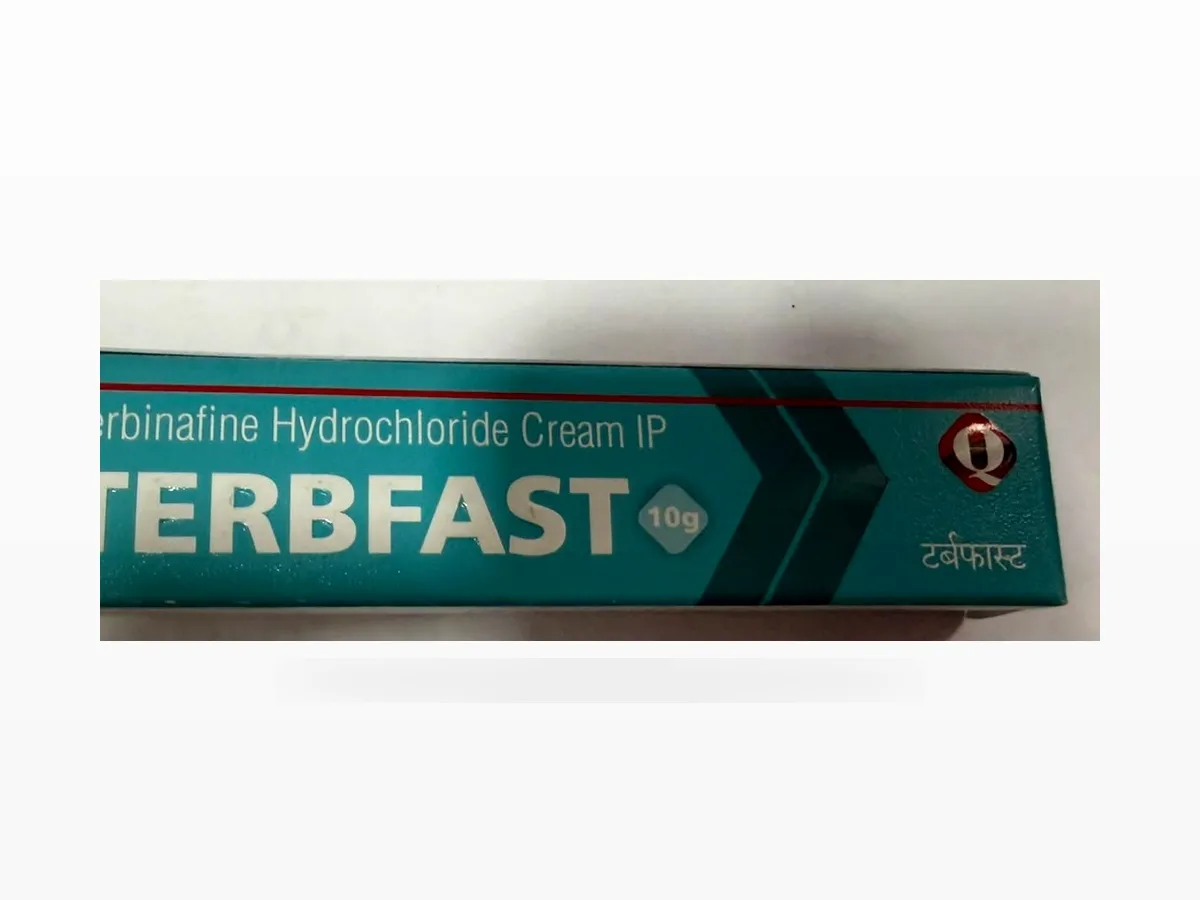
TERBFAST
Terbinafine
- Strength
- 1 % w/w
- Dosage form
- Cream
- Pack size
- 10 g
- Packing
- Tube
Product information
CLINICAL PHARMACOLOGY
Absorption
In a study of 12 patients with tinea cruris/corporis, TERBINEX (Terbinafine), 1%, was applied once daily for 7 days to the diseased area(s) as well as a 2.5 cm margin of healthy skin. The mean daily application ranged from 20.4 to 92.1 mg. Terbinafine plasma levels up to 2.37 ng/mL were detected in 6 out of 12 patients on Day 1 and plasma levels up to 6.84 ng/mL were detected in 10 out of 12 patients on Day 7. These plasma levels are 37 times lower than those observed after repeated once a day oral administration of 250 mg Terbinafine. The mean AUC0-24 on Day 7 was 40.5 ng.h/mL.
In a study of 12 healthy volunteers, Terbinex (Terbinafine), 1%, was applied once daily for 7 days to 20% of the body surface area with mean daily application of 67.5 ± 5.5 mg Terbinafine. On Day 1, the highest measured plasma concentration was 4.38 ng/mL at 10 hours post dose. On Day 7 all subjects had quantifiable Terbinafine concentrations with a maximum concentration of 9.72 ng/mL. The mean AUC0-24 on Day 7 was 62.6 ng.h/mL.
This is 0.6% of the AUC0-24 (10,481 ng.h/mL) in healthy subjects following 250 mg orally for
28 days.
Distribution
The skin pharmacokinetics of Terbinafine, 1%, was compared to Terbinafine Hydrochloride) Cream, 1%, (equivalent to 0.89% Terbinafine) in 36 volunteers with healthy skin. Groups of 6 subjects received a daily application for 1, 5, or 7 days. Approximately 5 mg of Terbinafine was applied to two areas on the back, each measuring 12x8 cm. Penetration into stratum corneum was assessed by 5 sequential skin surface biopsies of 2.5 micron thickness. There was no significant difference in the total stratum corneum AUC0-t between Terbinafine, 1% and Terbinafine Hydrochloride Cream, 1%, after 1.5 and 7 days of application.
Metabolism
It is unknown whether or not there is significant skin metabolism of topically applied Terbinafine. Radiolabeled studies with oral dosage forms indicate that Terbinafine is highly metabolized into a number of inactive metabolites which undergo conjugation and excretion into the urine. The primary metabolite seen in the urine (10% of the oral dose) is Ndemethyl Terbinafine. After topical application of Terbinafine, 1%, 2/12 patients and 6/12 healthy volunteers had detectable levels of the N- demethly metabolite in the plasma at day 7 with maximum concentration being 0.99 ng/mL and 2.57 ng/mL, respectively.
Elimination
Based on a series of studies, the total stratum corneum half-life of Terbinafine when absorbed through the skin is ~14-35 hours, depending on the topical dosage form of Terbinafine. In a study comparing the Terbinafine, 1%, with the (Terbinafine Hydrochloride) Cream, 1%, dosage form, the total stratum corneum t1/2 for Terbinafine after Day 7 application of was 27.2 h vs. 35.2 h for Terbinafine Hydrochloride Cream, 1%, (p<0.05). Approximately 75% of cutaneously absorbed Terbinafine is eliminated in the urine, predominately as metabolites.
Microbiology
Terbinafine is a synthetic allylamine derivative. Terbinafine is hypothesized to act by inhibiting squalene epoxidase, thus blocking the biosynthesis of erogosterol, an essential component of fungal cell membranes. The allylamine derivatives, like benzyl amines, act at an earlier step in the ergosterol biosynthesis pathway than the azole class of antifungal drugs. Depending on the concentration of the drug and the fungal species tested in vitro, Terbinafine may be fungicidal. However, the clinical significance of the in vitro data is unknown.
Terbinafine has been shown to be active against most strains of the following microorganisms, both in vitro and in clinical infections.
Epidermophyton floccosum
Malassezia furfur
Trichophyton mentagrophytes
Trichophyton rubrum
INDICATIONS AND USAGE
Terbfast (Terbinafine), 1%, is indicated for the topical treatment of the following dermatologic infections: tinea (pityriasis) versicolor due to Malassezia furfur (formerly Pityrosporum ovale), tinea pedis (athlete’s foot), tinea corporis (ringworm) or tinea cruris (jock itch) due to Trichophyton rubrum, Trichophyton mentagrophytes, or Epidermophyton floccosum. Diagnosis of disease should be confirmed either by culture (except Malassezia furfur, formerly Pityrosporum ovale) or examination of scrapings from infected tissue mounted in a solution of potassium hydroxide.
CONTRAINDICATIONS
Terbinafine, 1%, is contraindicated in individuals who have known or suspected hypersensitivity to Terbinafine or any other of its components.
WARNINGS
Terbfast (Terbinafine) is not for ophthalmic, oral, or intravaginal use.
PRECAUTIONS
General: 1%, contains 11.3% v/v alcohol. If irritation or sensitivity develops with the use of Terbfast (Terbinafine), 1%, treatment should be discontinued and appropriate therapy instituted.
Terbfast 1%, may be irritating to the eyes.
Information for Patients
The patient should be told to
- Use Terbfast (Terbinafine), as directed by the physician, and avoid contact with the eyes, nose, mouth, or other mucous membranes. In case of accidental contact with the eyes, rinse eyes thoroughly with running water and consult a physician, if any symptoms persist.
- Apply Terbfast (Terbinafine), 1%, once daily.
- Cleanse and dry the affected areas thoroughly before applying Terbfast (Terbinafine), 1%. Sufficient gel should be applied to cover the affected skin and surrounding area.
- Use the medication for the full treatment time, even though symptoms may have improved.
- Inform the physician if the area of application shows signs of increased irritation or possible sensitization (Redness, Itching, Burning, Blistering, Swelling, or Oozing).
- Notify the physician if there is no improvement after the full course of treatment.
- Avoid covering the affected areas with dressings, unless otherwise directed by the physician.
Drug Interactions
Potential interactions between Terbfast (Terbinafine), 1%, and other drugs have not been systematically evaluated.
Carcinogenesis, Mutagenesis, Impairment of Fertility
In a 28-month oral carcinogenicity study in rats, a marginal increase in the incidence of liver tumors was observed in males at the highest dose level, 69 mg/kg/day (in terms of mg/m2/day equivalent to 41 times the maximum potential exposure at the recommended topical human dose*). There was no dose-related trend, and the mid-dose male rats, 20 mg/kg/day (in terms of mg/m2/day equivalent to 12 times the maximum potential exposure at the recommended human topical dose*), did not have any liver tumors. No increased incidence in liver tumors was noted in female rats at dose levels up to 97 mg/kg/day (in terms of mg/m2/day equivalent to 58 times the maximum potential exposure at the recommended topical human dose*), or in male or female mice treated orally for 23 months at doses up to 156 mg/kg/day (in terms of mg/m2/day equivalent to 47 times the maximum potential exposure at the recommended topical human dose*).
A wide range of oral in vivo studies in mice, rats, dogs and monkeys, and in vitro studies using rat, monkey and human hepatocytes suggest that the development of liver tumors in the high-dose male rats may be associated with peroxisome proliferation and support the conclusion that this is a rat-specific finding.
The results of a variety of in vitro (mutations in E. coli and Salmonella typhimurium, DNA repair in rat hepatocytes, mutagenicity in Chinese hamster fibroblasts, chromosome aberration and sister chromatid exchanges in Chinese hamster lung cells), and in vivo (chromosome aberration in Chinese hamsters, micronucleus test in mice), genotoxicity tests gave no evidence of a mutagenic or clastogenic potential, and demonstrated the absence of tumor-initiating or cell-proliferating activity.
Oral reproduction studies in rats at doses up to 300 mg/kg/day (in terms of mg/m2/day equivalent to 180 times the maximum potential exposure at the recommended topical human dose*) did not reveal any specific effects on fertility or other reproductive parameters. Intravaginal application of Terbinafine Hydrochloride at 150 mg/day (in terms of mg/m2/day equivalent to 101 times the maximum potential exposure at the recommended topical human dose*) in pregnant rabbits did not increase the incidence of abortions or premature deliveries or fetal abnormalities.
Pregnancy
Pregnancy Category B: Oral doses of Terbinafine Hydrochloride up to 300 mg/kg/day (in terms of mg/m2/day equivalent to 180 and 404 times the maximum potential exposure at the recommended topical human dose*) during organogenesis in rats and rabbits, respectively, were not teratogenic. Similarly, a subcutaneous study in rats at doses up to 100 mg/kg/day (in terms of mg/m2/day equivalent to 60 times the maximum potential exposure at the recommended topical human dose*) and a percutaneous study in rabbits, including doses up to 150 mg/kg/day (in terms of mg/m2/day equivalent to 202 times the maximum potential exposure at the recommended topical human dose*) did not reveal any teratogenic potential. There are, however, no adequate and well-controlled studies in pregnant women.
Because animal reproduction studies are not always predictive of human response, 1%, should be used only if clearly indicated during pregnancy.
* The above comparisons between oral animal doses and maximum potential exposure at the recommended human topical dose are based upon the application to human skin of 0.1 mg of Terbinafine/cm2 once daily, the assumption of average human cutaneous exposure of 100 cm2, and the theoretical maximum human cutaneous absorption of 100%.
Nursing Mothers: After a single oral dose of 500 mg of Terbinafine Hydrochloride to two volunteers, the total dose of Terbinafine secreted in human milk during the 72-hour post dosing period was 0.65 mg in one person and 0.15 mg in the other. The total excretion of Terbinafine in human milk was 0.13% and 0.03% of the administered dose, respectively.
This 500 mg dose represents about 50 times the maximum potential percutaneous exposure as described in the previous paragraph. The concentrations of the Ndemethylated metabolite measured in the human milk of these two volunteers were below the detection limit of the assay used (150 ng/mL) of the assay.
Because of the small amount of data on human neonatal exposure, a decision should be made whether to discontinue nursing or to discontinue the drug, taking into account the importance of the drug to the mother.
Nursing mothers should avoid application of Terbinafine, 1%, to the breast.
Pediatric Use: The safety and efficacy of Terbinafine, 1%, have not been established in pediatric patients.
ADVERSE REACTIONS
Clinical Trials
In clinical trials, none of the 262 patients treated with Terbinex (Terbinafine), 1%, discontinued therapy due to adverse events. For Terbinex (Terbinafine), 1%, treated patients, adverse reactions thought to be possibly, probably, or definitely related to drug therapy included skin disorder ( 1.9%), application site reactions (burning or irritation) (1.5%), and pruritus (1.1 %). The following adverse events were seen only in patients with tinea cruris: skin discoloration (3/36), skin exfoliation (1/36) and contact dermatitis (1/36).
Skin discoloration consisted of hyperpigmentation which resolved in 1 patient during the trial. No follow-up information was available on the remaining 2 patients.
OVERDOSAGE
Clinical experience regarding overdose with is limited. Doses up to 5 grams of Terbinafine Hydrochloride (equivalent to approximately fifteen 30 gram tubes (Terbinafine), 1%) have been taken without inducing serious adverse reactions.
The symptoms of overdose associated with oral Terbinafine Hydrochloride included nausea, vomiting, abdominal pain, dizziness, rash, urinary frequency and headache. There has been no experience of overdose with topical formulations of Terbinafine. However, the alcohol content (11.3%) of (Terbinafine), 1%, has to be taken into account.
When (Terbinafine), 1%, was administered as a single oral dose at 10 or 25 mL/kg (100 and 250 mg/kg, respectively) to rats and mice, no deaths or other drug related toxicities were observed.
DOSAGE AND ADMINISTRATION
For the treatment of tinea (pityriasis) versicolor, tinea corporis, tinea cruris, and tinea pedis Terbfast (Terbinafine), 1%, is applied once daily for seven days. The affected areas should be cleansed and dried thoroughly before applying Terbfast (Terbinafine), 1%. Sufficient amounts should be applied to cover the treatment area(s) thoroughly, including the affected skin and surrounding area.