

MUPICOR
Mupirocin
- Dosage form
- Ointment
- Pack size
- 2% w/w
- Packing
- Tube
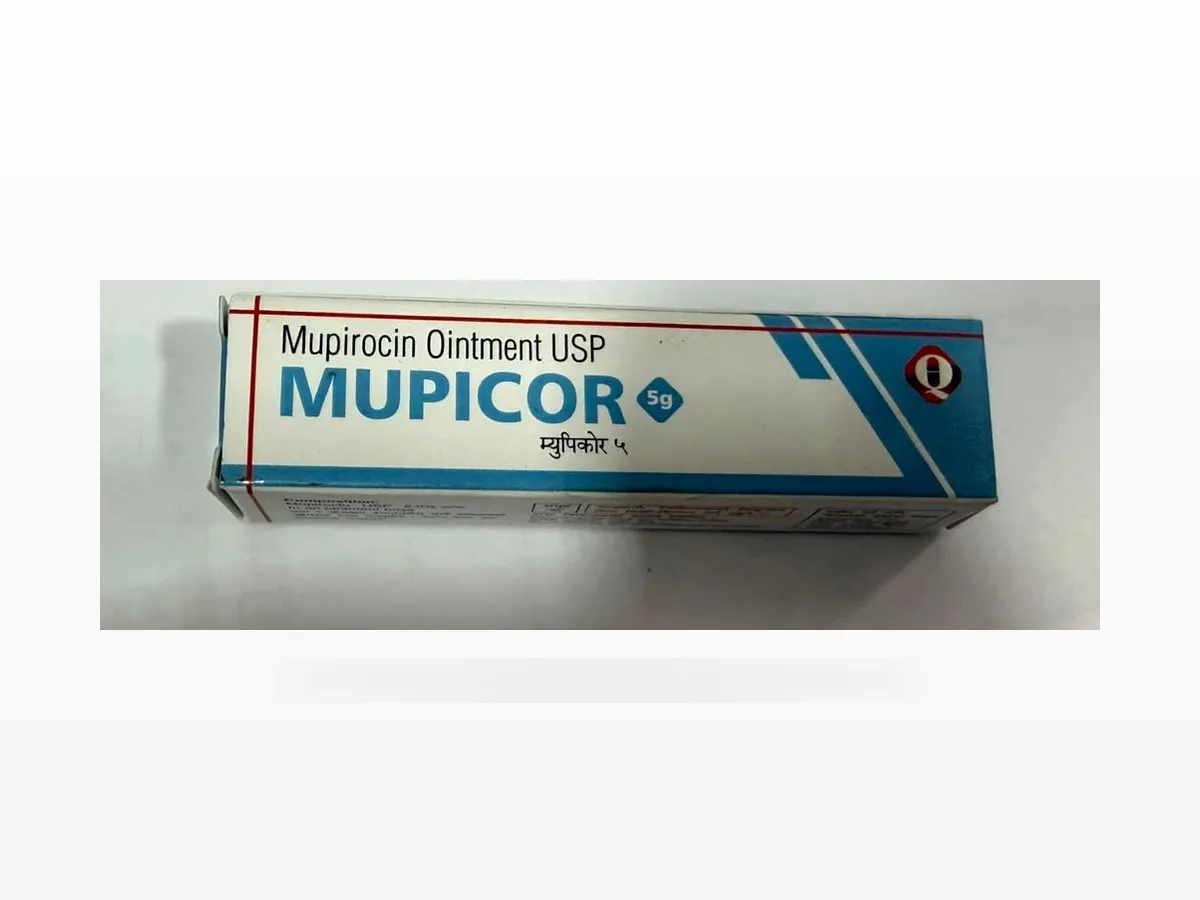
Product information
PRESENTATION
Brand Name: Mupicor
Generic name: Mupirocin
Dosage Form: Ointment
Strength: 2% w/w
Packing: Tube 5/10 gm.
Pharmacopoeia: USP
Group: KHA
CLINICAL PARTICULARS
Therapeutic Indications
Mupirocin is indicated in Adults and Children.
Mupirocin is a topical antibacterial agent, active against those organisms responsible for the majority of skin infections, e.g. Staphylococcus aureus, including methicillin-resistant strains, other staphylococci, and streptococci. It is also active against Gram-negative organisms such as Escherichia coli and Haemophilus influenzae. Mupirocin Ointment is used for skin infections, e.g. impetigo, folliculitis, furunculosis.
Posology and Method of Administration
Posology:
Adults (Including Elderly) and Pediatric Population:
Mupirocin Ointment should be applied to the affected area up to three times a day for up to 10 days.
The area may be covered with a dressing or occluded if desired.
Method of Administration
Topical
Do not mix with other preparations as there is a risk of dilution, resulting in a reduction of the antibacterial activity and potential loss of stability of the mupirocin in the ointment.
Contraindications
- Hypersensitivity to the active substance(s) or to any of the excipients.
- This Mupirocin Ointment formulation is not suitable for ophthalmic or intranasal use.
Special Warnings and Precautions for Use
Should a possible sensitization reaction or severe local irritation occur with the use of Mupirocin Ointment, treatment should be discontinued, the product should be washed off and appropriate therapy instituted.
As with other antibacterial products, prolonged use may result in overgrowth of non-susceptible organisms. Pseudomembranous colitis has been reported with the use of antibiotics and may range in severity from mild to life-threatening. Therefore, it is important to consider its diagnosis in patients who develop diarrhea during or after antibiotic use. Although this is less likely to occur with topically applied mupirocin, if prolonged or significant diarrhea occurs or the patient experiences abdominal cramps, treatment should be discontinued immediately and the patient investigated further.
Renal Impairment
Polyethylene glycol can be absorbed from open wounds and damaged skin and is excreted by the kidneys. In common with other polyethylene glycol-based ointments, Mupirocin Ointment should not be used in conditions where absorption of large quantities of polyethylene glycol is possible, especially if there is evidence of moderate or severe renal impairment.
Mupirocin Ointment is Not Suitable For:
- Ophthalmic Use
- Intranasal Use (In Neonates or Infants)
- Use in Conjunction With Cannula
- At The Site of Central Venous Cannulation
Avoid contact with the eyes. If contaminated, the eyes should be thoroughly irrigated with water until the ointment residues have been removed.
INTERACTION
No interaction studies have been performed
Fertility, Pregnancy and Lactation
Pregnancy:
Reproduction studies on mupirocin in animals have revealed no evidence of harm to the fetus. As there is no clinical experience on its use during pregnancy, Mupirocin Ointment should only be used in pregnancy when the potential benefits outweigh the possible risks of treatment.
Breast-Feeding:
It is unknown whether mupirocin is excreted in human milk. If a cracked nipple is to be treated, it should be thoroughly washed prior to breast-feeding.
Fertility
There are no data on the effects of mupirocin on human fertility. Studies in rats showed no effects on fertility.
Effects on Ability to Drive and Use Machines
Mupirocin 2% w/w Ointment has no or negligible influence on the ability to drive and use machines.
UNDESIRABLE EFFECTS
System Organ Class
Frequency
Undesirable Effects
Immune System Disorders
Very Rare
Systemic allergic reactions including anaphylaxis, generalized rash, urticaria and angioedema have been reported with Mupirocin Ointment.
Skin And Subcutaneous Tissue Disorders
Common
Uncommon
Burning localized to the area of application
Itching, erythema, stinging and dryness localized to the area of application. Cutaneous sensitization reactions to mupirocin or the ointment base.
Overdose
Symptoms
There is currently limited experience with over dosage of mupirocin.
Management
The toxicity of mupirocin is very low. In the event of accidental ingestion of the ointment, symptomatic treatment should be given.
In case of erroneous oral intake of large quantities of the ointment, renal function should be closely monitored in patients with renal insufficiency because of the possible side effects of polyethylene glycol.
There is no specific treatment for an overdose of mupirocin. In the event of overdose, the patient should be treated supportively with appropriate monitoring as necessary. Further management should be as clinically indicated or as recommended by the national poisons center, where available.
PHARMACOLOGICAL PROPERTIES
Pharmacodynamics Properties
Pharmacotherapeutic Group: Antibiotics and Chemotherapeutics for Topical Use.
Mechanism of Action
Mupirocin is a novel antibiotic produced through fermentation by Pseudomonas fluorescens. Mupirocin inhibits isoleucyl transfer-RNA synthetase, thereby arresting bacterial protein synthesis. Mupirocin has bacteriostatic properties at minimum inhibitory concentrations and bactericidal properties at the higher concentrations reached when applied locally.
Mechanism of Resistance
Low-level resistance in staphylococci is thought to result from point mutations within the usual staphylococcal chromosomal gene (ileS) for the target isoleucyl tRNA synthetase enzyme. High-level resistance in staphylococci has been shown to be due to a distinct, plasmid encoded isoleucyl tRNA synthetase enzyme.
Intrinsic resistance in Gram negative organisms such as the Enterobacteriaceae could be due to poor penetration of the outer membrane of the Gram-negative bacterial cell wall.
Due to its particular mode of action, and its unique chemical structure, mupirocin does not show any cross-resistance with other clinically available antibiotics.
Microbiological Susceptibility
The prevalence of acquired resistance may vary geographically and with time for selected species, and local information on resistance is desirable, particularly when treating severe infections. As necessary, expert advice should be sought when the local prevalence of resistance is such that the utility of the agent in at least some types of infection is questionable.
Commonly Susceptible Species Staphylococcus Aureus* Streptococcus Pyogenes* Streptococcus Spp. (Β -Hemolytic, Other Than S. Pyogenes) Species For Which Acquired Resistance May Be A Problem Staphylococcus Spp., Coagulase Negative Inherently Resistant Organisms Corynebacterium Spp. Micrococcus Spp.* Activity has been satisfactorily demonstrated in clinical studies
Pharmacokinetic Properties
After topical application of Mupirocin Ointment, mupirocin is only very minimally absorbed systemically and that which is absorbed is rapidly metabolized to the antimicrobially inactive metabolite, monic acid. Penetration of mupirocin into the deeper epidermal and dermal layers of the skin is enhanced in traumatized skin and under occlusive dressings.
Elderly
No restrictions unless there is evidence of moderate or severe renal impairment.
Preclinical Safety Data
Pre-clinical effects were seen only at exposures which are extremely unlikely to cause concern for humans under normal conditions of use. Mutagenicity studies revealed no risks to man.
Special Precautions for Storage
Do not store above 25° C.