

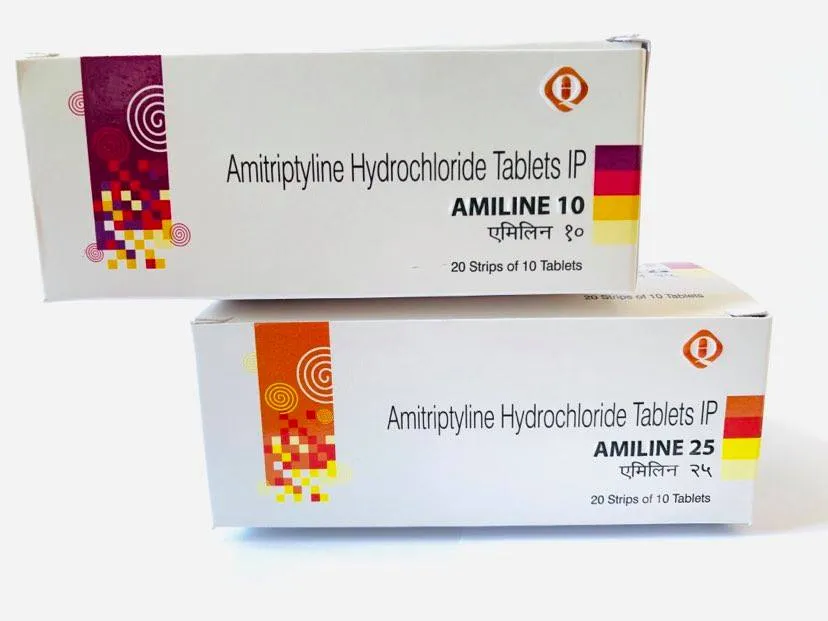
Amiline
Amitriptyline HCl
- Strength
- 10/25/75
- Dosage form
- tablets
- Pack size
- 20*10 Blisters
- Packing
- blister
Product information
PRESENTATION
Dosage Form: Tablet
Generic: Amitriptyline Hydrochloride
Strength: 10/25 & 75 mg.
Pack size: 20*10
Packing: Blisters
CLINICAL PHARMACOLOGY
Pharmacotherapeutic Group: Antidepressants - Non-Selective Monoamine Reuptake Inhibitor (Tricyclic Antidepressant)
Mechanism of Action
AMILINE is a tricyclic antidepressant and an analgesic. It has marked anticholinergic and sedative properties. It prevents the re-uptake, and hence the inactivation of noradrenaline and serotonin at nerve terminals. Reuptake prevention of these monoamine neurotransmitters potentiate their action in the brain. This appears to be associated with the antidepressant activity.
The mechanism of action also includes ion-channel blocking effects on sodium, potassium and NMDA channel at both central and spinal cord level. The noradrenaline, sodium and the NMDA effects are mechanisms known to be involved in the maintenance of neuropathic pain, chronic tension type headache prophylaxis and migraine prophylaxis. The pain-reducing effect of amitriptyline is not linked to its anti-depressive properties. Tricyclic antidepressants possess affinity for muscarinic and histamine H1 receptors to varying degrees.
Pharmacokinetic Properties
- Absorption: Oral administration of tablets results in maximum serum levels in about 4 hours. (Tmax = 3.89±1.87 hours; range 1.93-7.98 hours). After per oral administration of 50 mg the mean Cmax = 30.95±9.61 ng/ml; range 10.85-45.70 ng/ml (111.57±34.64 nmol/l; range 39.06-164.52 nmol/l). The mean absolute oral bioavailability is 53% (Fabs = 0.527±0.123; range 0.219-0.756).
- Distribution: The apparent volume of distribution (Vd) β estimated after intravenous administration is 1221 L±280 L; range 769-1702 L (16±3 L/kg). The plasma protein binding is about 95%. Amitriptyline and the main metabolite nortriptyline pass across the placental barrier. In nursing mothers amitriptyline and nortriptyline are excreted in small amounts with the breast milk. The ratio milk concentration/plasma concentration in women is around 1:1. The estimated daily infant exposure (amitriptyline + nortriptyline) averages 2% of the corresponding maternal weight related doses of amitriptyline (in mg/kg).
- Biotransformation: In vitro the metabolism of AMILINE proceeds mainly by demethylation (CYP2C19, CYP3A4) and hydroxylation (CYP2D6) followed by conjugation with glucuronic acid. Other isozymes involved are CYP1A2 and CYP2C9. The metabolism is subject to genetic polymorphism. The main active metabolite is the secondary amine, nortriptyline.
Nortriptyline is a more potent inhibitor of noradrenaline than of serotonin uptake, while amitriptyline inhibits the uptake of noradrenaline and serotonin equally well. Other metabolites such as cis- and trans-10-hydroxyamitriptyline and cis- and trans-10-hydroxynortriptyline have the same profile as nortriptyline but is considerably weaker. Demethylnortriptyline and amitriptyline N oxide are only present in plasma in minute amounts; the latter is almost inactive. All the metabolites are less anticholinergic than amitriptyline and nortriptyline. In plasma the amount of total 10-hydroxynortriptyline dominates but most of the metabolites are conjugated.
- Elimination
The elimination half-life (t½ β) AMILINE after per oral administration is about 25 hours (24.65±6.31 hours; range 16.49-40.36 hours). The mean systemic clearance (Cls) is 39.24±10.18 L/h, range 24.53-53.73 L/h. The excretion proceeds mainly with urine. The renal elimination of unchanged amitriptyline is insignificant (about 2%). Steady state plasma levels of amitriptyline + nortriptyline are reached within a week for most patients, and in steady state the plasma level comprises approximately equal parts of amitriptyline and nortriptyline around the clock following treatment with conventional tablets 3 times a day.
DRUG INTERACTIONS
Contraindicated Combinations
MAOIs (non-selective as well as selective A (moclobemide) and B (selegiline)) - Risk of “Serotonin Syndrome”.
Combinations That Are Not Recommended
- Sympathomimetic Agents: AMILINE may potentiate the cardiovascular effects of adrenaline, ephedrine, isoprenaline, noradrenaline, phenylephrine, and phenylpropanolamine (e.g. as contained in local and general anesthetics and nasal decongestants).
- Adrenergic Neuron Blockers: Tricyclic antidepressants may counteract the antihypertensive effects of centrally acting antihypertensive such as guanethidine, betanidine, reserpine, clonidine and methyldopa. It is advisable to review all antihypertensive therapy during treatment with tricyclic antidepressants.
- Anticholinergic Agents: Tricyclic antidepressants may potentiate the effects of these drugs on the eye, central nervous system, bowel and bladder; concomitant use of these should be avoided due to an increased risk of paralytic ileus, hyperpyrexia, etc. Drugs which prolong the QT-interval including antiarrhythmic such as amiodarone (avoid concomitant use), disopramide, procainamide, propafenone, quinidine, the antihistamines astemizole and terfenadine, some antipsychotics (notably pimozide and sertindole), cisapride, halofantrine, and sotalol, may increase the likelihood of ventricular arrhythmias when taken with tricyclic antidepressants.
- Use caution when using amitriptyline and methadone concomitantly due to a potential for additive effects on the QT interval and increased risk of serious cardiovascular effects. Caution is also advised for co-administration of amitriptyline and diuretics inducing hypokalemia (e.g. furosemide)
- Thioridazine: Co-administration of AMILINE and thioridazine (CYP2D6 substrate) should be avoided due to inhibition of thioridazine metabolism and consequently increased risk of cardiac side effects.
- Tramadol: Concomitant use of tramadol (a CYP2D6 substrate) and tricyclic antidepressants (TCAs), such as amitriptyline increases the risk for seizures and serotonin syndrome. Additionally, this combination can inhibit the metabolism of tramadol to the active metabolite and thereby increasing tramadol concentrations potentially causing opioid toxicity.
- Antifungals such as fluconazole and terbinafine increase serum concentrations of tricyclic and accompanying toxicity. Syncope and torsade de pointes have occurred.
Combinations Requiring Precautions for Use
- CNS depressants: AMILINE may enhance the sedative effects of alcohol, barbiturates and other CNS depressants.
- Potential of other medicinal products to affect AMILINE: Tricyclic antidepressants (TCA) including AMILINE are primarily metabolized by the hepatic cytochrome P450 isozymes CYP2D6 and CYP2C19, which are polymorphic in the population. Other isozymes involved in the metabolism of amitriptyline are CYP3A4, CYP1A2 and CYP2C9.
- CYP2D6 inhibitors
- Other Cytochrome P450 inhibitors: Cimetidine, methylphenidate and calcium-channel blockers (e.g. diltiazem and verapamil) may increase plasma levels of tricyclic antidepressants and accompanying toxicity. Antifungals such as fluconazole (CYP2C9 inhibitor) and terbinafine (CYP2D6 inhibitor) have been observed to increase serum
- Cytochrome P450 inducers: Oral contraceptives, rifampicin, phenytoin, barbiturates, carbamazepine and St. John's Wort (Hypericum perforatum) may increase the metabolism of tricyclic antidepressants and result in lowered plasma levels of tricyclic antidepressants and reduced antidepressant response.
- Alpha2-adrenoceptor stimulants
- Concomitant use of apraclonidine and brimonidine should be avoided.
- Altretamine
- Risk of severe postural hypotension.
- Anesthetics
- Concomitant therapy may increase the risk of arrhythmias and hypotension. If surgery is necessary, the anesthetist should be informed that a patient is being so treated
- Analgesics
- There is a possibility of increased side effects with nefopam. There is a possibility of increased sedation with opioid analgesics.
- Antibacterial
- Concomitant use with linezolid may result in CNS excitation and hypertension.
- Anxiolytics and hypnotics
- Concomitant use enhances the sedative effect. Caution is advised if patients receive large doses of ethchlorvynol concurrently. Transient delirium has been reported in patients treated with 1g ethchlorvynol and 75mg to 150mg of amitriptyline.
- Disulfiram
- Concomitant use may inhibit the metabolism of tricyclics. Delirium has been reported in patients taking amitriptyline with disulfiram.
- Diuretics
- Increased risk of postural hypotension.
- Dopaminergic
- Concomitant use with entacapone should be avoided. CNS toxicity has been reported with selegiline.
- Muscle Relaxants
- Concomitant use of baclofen enhances its muscle relaxant effect.
- Nitrates
- Reduced effect of sublingual nitrates (owing to dry mouth).
- Estrogens and Progestogens
- Oral contraceptives antagonize the antidepressant effect but side-effects may be increased due to increased plasma concentrations of tricyclics.
- Sibutramine
- Concomitant use is not recommended due to the increased risk of CNS toxicity.
INDICATIONS
AMILINE Tablets Are Indicated For:
- Major Depressive Disorder
- Neuropathic Pain
- The Prophylactic Treatment of Chronic Tension Type Headache (CTTH) in Adults
- The Prophylactic Treatment of Migraine in Adults
- Nocturnal Enuresis in Children Aged 6 Years
DOSAGE AND METHOD OF ADMINISTRATION
AMILINE tablet is for oral use. The tablets should be swallowed with water.
Major Depressive Disorder
Adults
Initially 25 mg 2 times daily (50 mg daily). If necessary, the dose can be increased by 25 mg every other day up to 150 mg daily divided into two doses.
The maintenance dose is the lowest effective dose.
Elderly patients over 65 years of age and patients with cardiovascular disease Initially 10 mg – 25 mg daily. The daily dose may be increased up to 100 mg – 150 mg divided into two doses, depending on individual patient response and tolerability. Doses above 100 mg should be used with caution. The maintenance dose is the lowest effective dose.
Pediatrics Population
AMILINE should not be used in children and adolescents aged less than 18 years, as long term safety and efficacy have not been established.
Duration of Treatment
The antidepressant effect usually sets in after 2 - 4 weeks. Treatment with antidepressants is symptomatic and must therefore be continued for an appropriate length of time usually up to 6 months after recovery in order to prevent relapse.
Adults
Recommended doses are 25 mg - 75 mg daily in the evening. Doses above 100 mg should be used with caution. The initial dose should be 10 mg - 25 mg in the evening. Doses can be increased with 10 mg - 25 mg every 3 – 7 days as tolerated.
The dose can be taken once daily, or be divided into two doses. A single dose above 75 mg is not recommended.
- The analgesic effect is normally seen after 2 - 4 weeks of dosing.
- Elderly patients over 65 years of age and patients with cardiovascular disease
- A starting dose of 10 mg - 25 mg in the evening is recommended.
- Doses above 75 mg should be used with caution.
It is generally recommended to initiate treatment in the lower dose range as recommended for adult. The dose may be increased depending on individual patient response and tolerability.
Pediatrics Population
AMILINE should not be used in children and adolescents aged less than 18 years, as safety and efficacy have not been established.
Duration of Treatment
Neuropathic Pain
Treatment is symptomatic and should therefore be continued for an appropriate length of time. In many patients, therapy may be needed for several years.
Nocturnal Enuresis
Pediatrics Population
The Recommended Doses For:
- Children Aged 6 To 10 Years: 10 mg – 20 mg. A suitable dosage form should be used for this age group.
- Children Aged 11 Years And Above: 25 mg – 50 mg daily
The dose should be increased gradually. Dose to be administered 1-1½ hours before bedtime.
An ECG should be performed prior to initiating therapy with amitriptyline to exclude long QT syndrome. The maximum period of treatment course should not exceed 3 months. If repeated courses of amitriptyline are needed, a medical review should be conducted every 3 months. When stopping treatment, AMILINE should be withdrawn gradually.
SIDE-EFFECTS
AMILINE may induce side effects similar to other tricyclic antidepressants. Some of the below mentioned side effects e.g. headache, tremor, disturbance in attention, constipation and decreased libido may also be symptoms of depression and usually attenuate when the depressive state improves.
In the listing below the following convention is used:
MedDRA system organ class / preferred term;
Very common (> 1/10);
Common (> 1/100, < 1/10);
Uncommon (> 1/1,000, < 1/100);
Rare (> 1/10,000, < 1/1,000);
Very rare (<1/10,000);
Frequency Not Known (Cannot Be Estimated From the Available Data)
MedDRA SOC
Frequency
Preferred Term
Blood And Lymphatic System Disorders
Rare
Bone marrow depression, agranulocytosis, leucopenia, eosinophilia, thrombocytopenia and purpur
Metabolism And Nutrition Disorders
Rare
Decreased appetite.
Frequency not known
Elevation or lowering of blood sugar levels. Increased appetite. Anorexia
Psychiatric Disorders
Very common
Aggression.
Common
Confusional state, libido decreased, agitation.
Uncommon
Hypomania, mania, anxiety, insomnia, nightmares.
Rare
Delirium (in elderly patients), hallucination (in schizophrenic patients), suicidal thoughts or behavior*.
Frequency not known
Paranoia.
Nervous System Disorders
Very common
Somnolence, tremor, dizziness, headache, drowsiness, speech disorder (dysarthria).
Common
Disturbance in attention, dysgeusia. Paresthesia, ataxia.
Uncommon
Convulsion.
Very rare
Akathisia, polyneuropathy.
Frequency not known
Weakness, disturbed concentration, disorientation, delusions, restlessness, peripheral neuropathy, inco-ordination, extrapyramidal disorder.
Eye Disorders
Very common
Accommodation disorder.
Common
Mydriasis.
Very rare
Acute glaucoma.
Frequency not known
Blurred vision, dry eye
Ear And Labyrinth Disorders
Uncommon
Tinnitus.
Cardiac Disorders
Very common
Palpitations, tachycardia.
Common
Atrioventricular block, bundle branch block
Uncommon
Collapse conditions, worsening of cardiac failure.
Rare
Arrhythmia.
Very rare
Cardiomyopathies, torsades de pointes.
Frequency not known
Hypersensitivity myocarditis, myocardial infarction
Vascular Disorders
Very common
Orthostatic hypotension.
Uncommon
Hypertension.
Frequency not known
Hyperthermia, stroke.
Respiratory, Thoracic, And Mediastinal Disorders
Very common
Congested nose.
Very rare
Allergic inflammation of the pulmonary alveoli and of the lung tissue, respectively (alveolitis, Loffler’s syndrome).
Gastrointestinal Disorders
Very common
Dry mouth, constipation, nausea.
Uncommon
Diarrhea, vomiting, tongue edema.
Rare
Salivary gland enlargement, ileus paralytic.
Frequency not known
Epigastric distress, stomatitis, black tongue.
Hepatobiliary Disorders
Rare
Jaundice.
Uncommon
Hepatic impairment (e.g. cholestasis liver disease).
Not known
Hepatitis.
Skin And Subcutaneous Tissue Disorders
Very common
Hyperhidrosis.
Uncommon
Rash, urticaria, face edema.
Rare
Alopecia, photosensitivity reaction.
Renal And Urinary Disorders
Common
Micturition disorders.
Uncommon
Urinary retention.
Reproductive System And Breast Disorders
Common
Erectile dysfunction.
Uncommon
Galactorrhoea.
Rare
Gynaecomastia.
Frequency not known
Breast enlargement, testicular swelling, libido fluctuations, interference with sexual function, and syndrome of inappropriate ADH secretion.
General Disorders And Administration Site Conditions
Common
Fatigue, feeling thirst.
Rare
Pyrexia
Investigations
Very common
Weight increased.
Common
Electrocardiogram abnormal, electrocardiogram QT prolonged, electrocardiogram QRS complex prolonged, hyponatremia.
Uncommon
Intraocular pressure increased.
Rare
Weight decreased.
Liver function test abnormal, blood alkaline phosphatase increased, transaminases increased.
WARNINGS AND PRECAUTIONS
Cardiac arrhythmias and severe hypotension are likely to occur with high dosage. They may also occur in patients with pre-existing heart disease taking normal dosage.
- QT Interval Prolongation
- Suicide/Suicidal Thoughts
- Nocturnal Enuresis
- Pediatric Population
CONTRAINDICATIONS
- Hypersensitivity to the active substance or to any of the excipients.
- Recent myocardial infarction.
- Any degree of heart block or disorders of cardiac rhythm and coronary artery insufficiency. Concomitant treatment with MAOIs (Monoamine Oxidase Inhibitors) is contra-indicated.
- Treatment with amitriptyline may be instituted 14 days after discontinuation of irreversible non-selective MAOIs and minimum one day after discontinuation of the reversible moclobemide.
- Treatment with MAOIs may be introduced 14 days after discontinuation of amitriptyline.
- Severe Liver Disease.
- In children under 6 years of age.
STORAGE
Store in cool and dry place. Keep out of reach of children.